
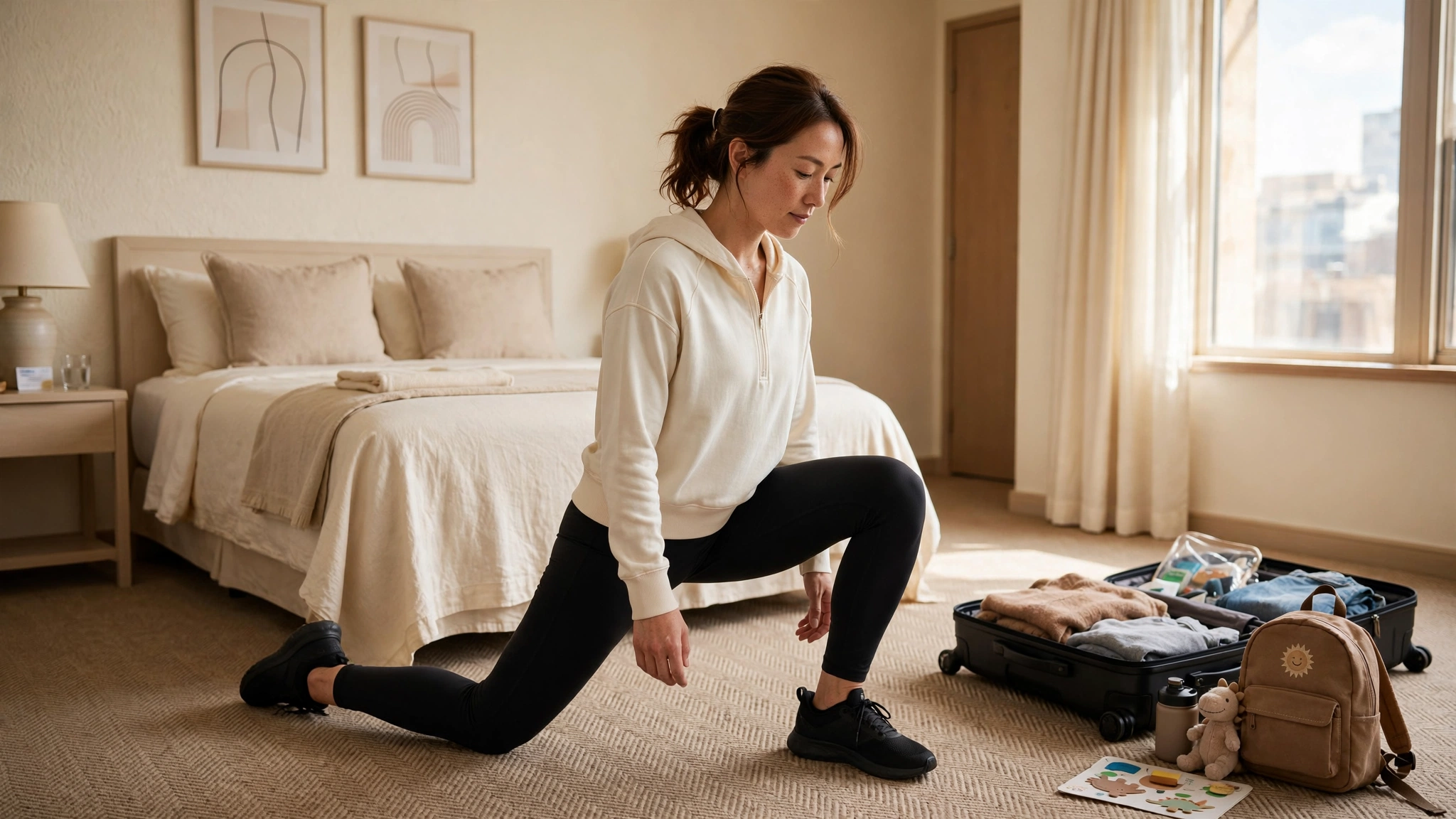
Can you get a real workout in a hotel room with no equipment? Yes. A floor space about the size of a yoga mat, a few bodyweight movements, and 15 to 20 minutes are enough to work your legs, upper body, core, and heart rate. The harder part on a travel day is deciding when to fit it in, with kids, luggage, and a schedule that belongs to someone else.
This guide covers how to plan no-equipment travel workouts, how to adapt bodyweight exercises to a small space, and how to keep the whole thing flexible enough for a trip with children. If you are looking for ideas for a regular day at home, our article on fitting a no-equipment workout into a busy day at home covers that.
Start with the space you actually have
Before you pick exercises, look at the room. You need a patch of floor where you can stand with your arms out and lie down flat. In many hotel rooms that is the strip between the bed and the wall, the area by the window, or the floor beside the desk. A bathroom floor works when the room is crowded and the kids are asleep.
A few quick checks make a small space safer to train in:
- Clear the path. Move shoes, bags, and cords out of the way before you start.
- Check the floor. Carpet gives you grip and cushions your knees and hands. On a hard or slippery floor, wear your sneakers or place a towel under your hands and knees.
- Think about the room below. If you are on an upper floor, choose low-impact versions of moves and save the jumping for another day.
- Use the furniture you have. A sturdy bed edge, a desk, or a wall can support incline push-ups, wall sits, or balance work. Test that it is stable first.
Bodyweight moves that fit in a small space
The best small-space bodyweight workouts rely on movements that stay in one spot. These categories cover the whole body and need no gear:
Legs and glutes
Squats, reverse lunges, split squats, and glute bridges all work within a one-person footprint. Reverse lunges and split squats take less room than walking lunges, and glute bridges only need a bit of floor to lie on.
Upper body
Push-ups can be done on the floor, on your knees, or with your hands on a sturdy surface like the edge of a desk or bed. Raising your hands makes the move easier, so you can pick the height that suits you today.
Core
Planks, dead bugs, and bird dogs build trunk strength while keeping you low and quiet. They are good picks when a little one is sleeping nearby.
Heart rate
You can raise your heart rate without leaving the spot. Marching in place, fast step-backs, and squat pulses all count. If the room below is someone else's ceiling, keep your feet light and avoid jumping.
A simple structure for a travel workout
You do not need a detailed program on the road. A repeatable structure is easier to follow than a long list of exercises, and it adjusts to however much time the day gives you.
- Warm up for two to three minutes. March in place, roll your shoulders, and do a few easy bodyweight squats.
- Pick four moves. Choose one for legs, one for upper body, one for core, and one for your heart rate.
- Work in rounds. Do each move for a set number of repetitions or a set amount of time, rest briefly, and repeat the round as many times as your time allows.
- Finish with a short stretch. Spend a minute or two easing out your hips, calves, and shoulders, especially after a long flight or drive.
If all you have is ten minutes, one round of four moves still counts. A short session you complete is worth more than a long one you skip.
Make it work with kids on the trip
Travel workouts rarely happen in silence. These approaches keep them realistic:
- Train while the day is already paused. Nap time, the first few minutes after kids settle in front of a show, or the stretch before everyone wakes up all work.
- Let kids join in. Toddlers often enjoy copying squats and marches, and older children can count repetitions for you.
- Split the session. Do two rounds in the morning and two before bed. Short blocks add up and are easier to start.
- Set a low bar on hard days. After a delayed flight or a long drive, a stretch and a few squats are a perfectly good choice.
A note on listening to your body
Travel can leave you stiff, tired, and out of your normal routine, so start lighter than you would at home and build up as your body warms. Stop if something hurts, and choose easier variations when you need them. If you are pregnant, recently postpartum, recovering from an injury, or have a health condition, check with your healthcare provider about which exercises are right for you before starting a new routine.
A quick pre-trip checklist
A few minutes of planning before you leave makes it easier to move once you arrive:
- Pack sneakers and a comfortable outfit you can put on quickly.
- Save your four-move workout in your phone notes so you do not have to decide from scratch.
- Pick a time of day that fits the trip, and treat it as flexible.
- Bring a small towel if you expect hard floors.
- Decide in advance what your minimum looks like, such as one round of four moves.
If you want a guide to follow
Some moms like to build their own routine. Others prefer something ready to follow. Move Anywhere, Train Everywhere is a digital no-equipment bodyweight fitness guide made for use at home or while traveling, with strength and cardio training in mind. You can read the product page for the full details.
The short version
You do not need a gym, equipment, or a spacious room to move on a trip. Find a patch of floor, pick four bodyweight moves, work in rounds, and let the session be as long as your day allows. Consistency on the road comes from a plan that is small enough to do.
