
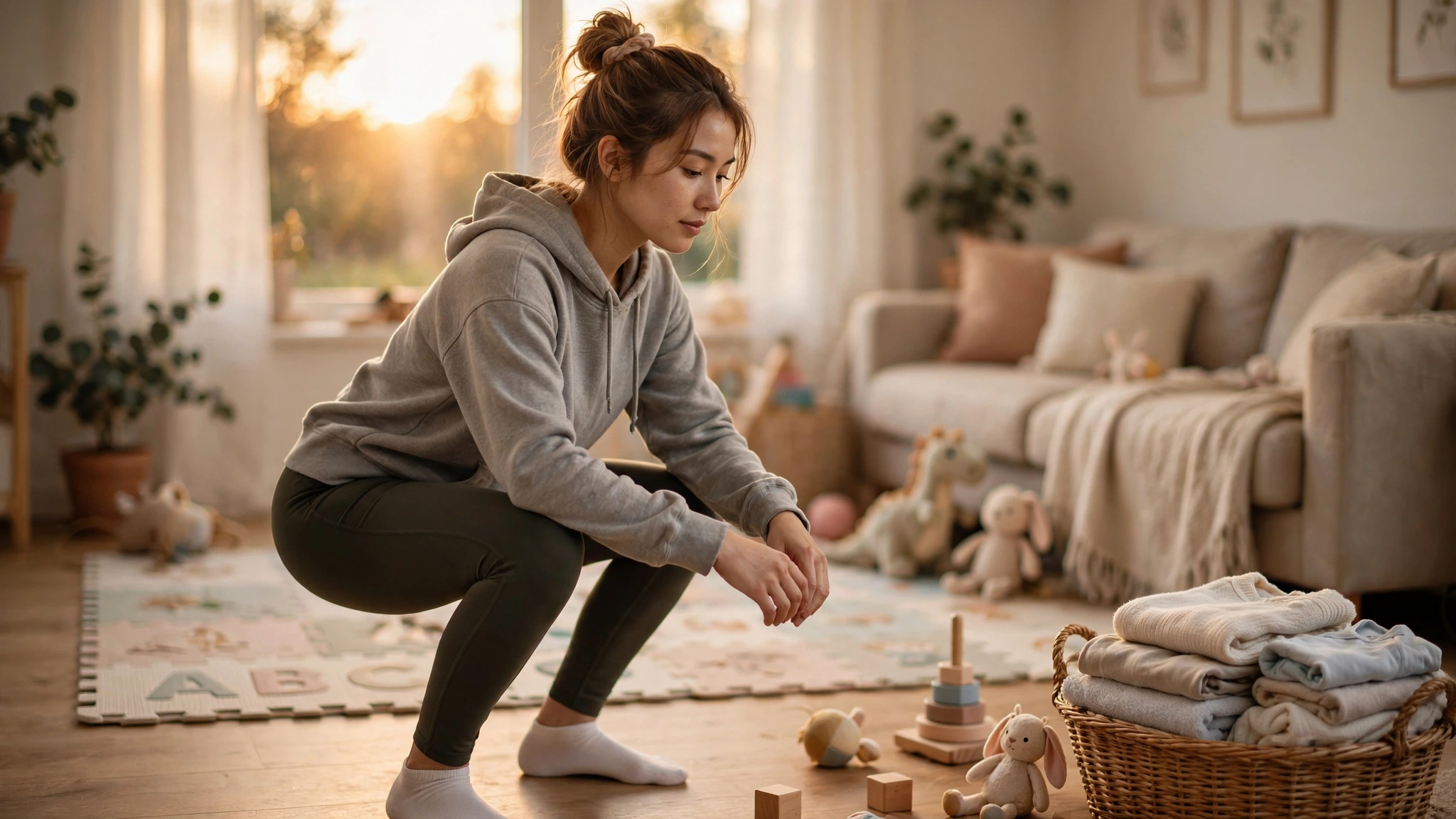
You can fit a no-equipment workout into a busy day at home by dropping the idea that it needs a clear hour, a quiet room, or a full set-up. Bodyweight exercise asks for a patch of floor roughly the size of a yoga mat and a few minutes you already have. This article shows where those minutes tend to hide and how to use them, even when the living room is covered in toys.
Start with the space you already have
Most home workouts get skipped before they start because the room does not look ready. Toys on the floor, laundry on the couch, a baby napping in the next room. A bodyweight routine does not need any of that fixed first.
Look for one spot where you can stand with your arms out and step back one stride. That is enough for most of the movements below. Good candidates:
- The gap between the couch and the coffee table
- A strip of hallway or kitchen floor
- The corner of a bedroom beside the bed
- A rug or play mat, if your kids are playing on it and you can share the space
Wear what you already have on, and take shoes off if you feel steadier barefoot or in grippy socks. Choose a surface that does not slip.
Find the minutes your day already holds
Instead of searching for a free 45 minutes, look for the small gaps that repeat every day. Those gaps make a routine easier to keep, because you are attaching it to something that already happens.
- While the kettle boils or coffee brews. The wait is built in, and you are standing in the kitchen anyway.
- During a nap or quiet time. If you have a stretch of calm, you can decide whether to use it for movement, rest, or chores. All three are fair choices.
- Before the shower. Moving first gives the day a clear marker, and cleaning up afterward is already planned.
- While kids play nearby. Some kids like to copy what you do. Others ignore you completely. Either one works.
- After bedtime. If your evenings are your own, a short session before you sit down can be easier than starting once you are settled.
Pick one or two of these and keep the rest as backups. A routine tied to one reliable moment is easier to repeat than one that depends on finding time each day.
Bodyweight movements that suit a small space
These classic movements need no equipment and stay mostly in one spot. Most can be made easier or harder by changing the range or the pace.
- Squats: feet about hip-width apart, sit your hips back as if toward a chair, then stand. A chair behind you can act as a guide.
- Reverse lunges: step one foot back, lower, and return. Stepping back takes less room than stepping forward.
- Glute bridges: lie on your back with knees bent and lift your hips. A rug or mat is enough.
- Counter or wall push-ups: place your hands on the kitchen counter or a wall and lean in. A higher surface makes the movement lighter.
- Marching or step-backs in place: raise your heart rate without jumping, which is considerate when someone is sleeping or neighbors live below.
- Forearm planks or knee planks: hold a steady position for a short time and stop when your form changes.
Move at a pace that feels controlled. If something hurts, stop and choose a different movement. If you are recovering from childbirth or have a health condition, ask your healthcare provider what kinds of exercise are right for you before you begin.
A simple way to put it together
You do not need a formal plan to begin. Here is one flexible pattern you can adjust:
- Choose three movements from the list, for example squats, glute bridges, and counter push-ups.
- Do each one for a number of repetitions that feels steady, then move to the next.
- Repeat the round as many times as your gap allows, whether that is once or a few times.
- Finish when the time is up, not when you feel you have earned it.
On the days when only a few minutes appear, one round counts as showing up. On days with more time, add rounds or another movement. Consistency across ordinary weeks is easier to build from small, repeatable sessions than from occasional big ones.
Make it easier to start next time
Small preparations remove friction. Decide the night before when you will move. Keep a mat, or a spare towel, somewhere you can reach it. Keep your list of three movements on your phone or on the fridge so you never have to decide in the moment.
It also helps to define a minimum version. Perhaps it is ten squats while the coffee brews. A minimum you can always do keeps the habit alive on the days when everything else goes sideways, and those days are common in a house with kids.
If you want a ready-made routine
Planning your own routine works well for some people. Others would rather have the structure written out. If that sounds like you, the digital guide Train Better Every Day with Just Your Body and a Bit of Space is an at-home bodyweight routine guide written for busy people. You can read the listing for what it covers, along with current pricing and purchase details.
If you would like to compare options, including a guide for home and travel and one on exercising without a gym, you can browse the full workout guide collection. Each listing shows its own current details.
The short version
- You need a mat-sized patch of floor, not a clean room.
- Attach movement to a moment that already repeats, such as the kettle, the nap, or the shower.
- Choose three simple bodyweight movements and repeat them in rounds.
- Set a minimum version for the days that get away from you.
- Check with a healthcare provider first if you are postpartum or have health concerns.
Your day is already full. A few steady minutes of movement at home can fit into it without asking you to rearrange everything else.
